Russia has tested a new intercontinental ballistic missile.
"Sarmat" missiles are designed to replace the "Voevoda" missile and are equipped with multiple independently targetable reentry vehicles.
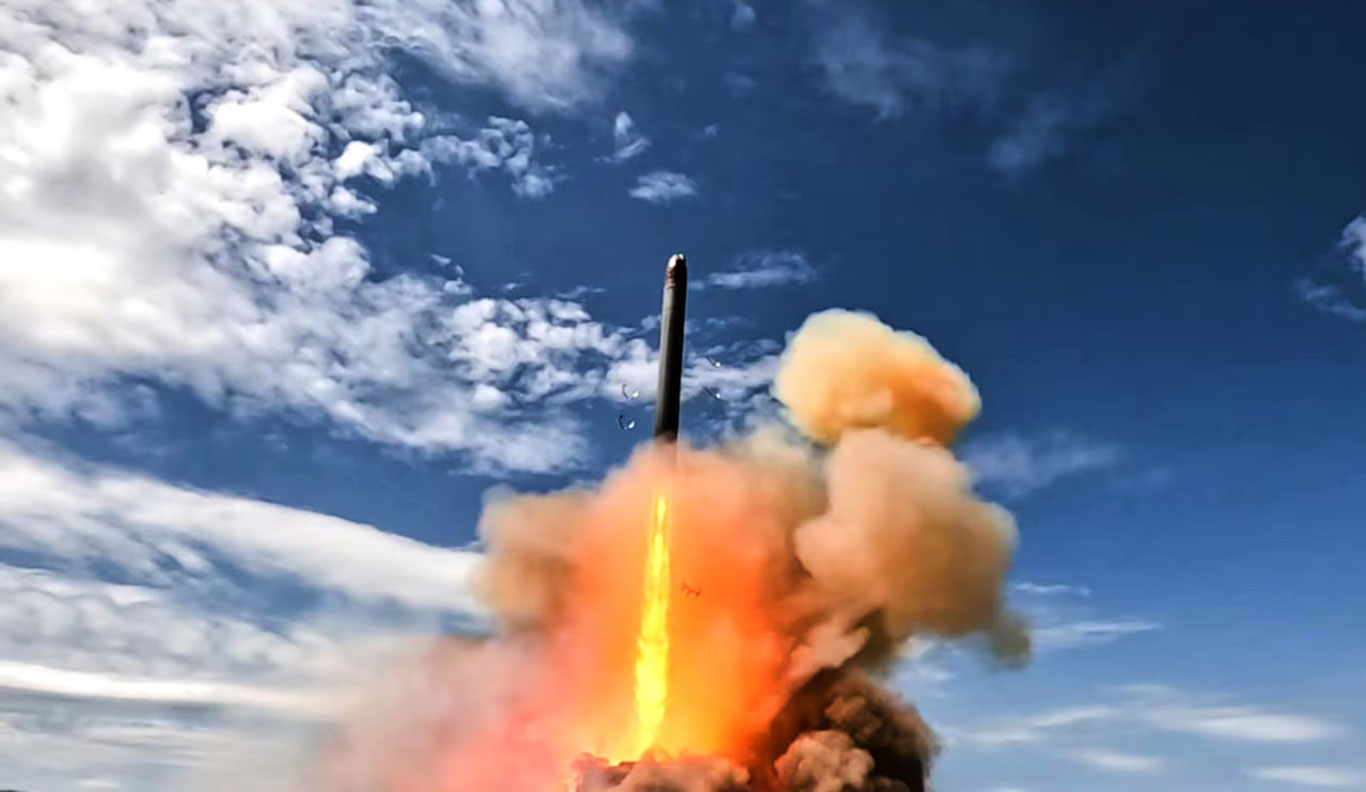
Russia tested a new intercontinental ballistic missile on Tuesday as part of its nuclear forces modernization. The Associated Press reported on this.
According to reports, the test results were positively assessed by President Vladimir Putin, who described the missile as "the most powerful missile in the world." This test took place just a few days after Putin's statement that the war in Ukraine would soon end.
According to official data, the "Sarmat" intercontinental ballistic missile, capable of carrying nuclear warheads, is planned to be put into combat service by the end of the year. It is designed to replace the "Voevoda" system developed during the Soviet era.
Putin highly praised the combat capabilities of the "Sarmat," emphasizing that its warheads, which can be directed at specific targets, have a total power several times greater than that of analogous systems in Western countries.
According to him, the missile possesses high accuracy and suborbital flight capability, can cover a distance of over 35,000 kilometers, and has the ability to bypass existing missile defense systems.
The "Sarmat" system is also known in the West as "Satan II" and is intended to replace approximately 40 "Voevoda" missiles left over from the Soviet era. Its development began in 2011.
During the testing process, it was noted that the missile was successfully launched only once, while reports circulated that an explosion occurred during an unsuccessful test in 2024.
In recent years, Russia has been extensively modernizing its nuclear "triad" — the land, sea, and air components. Hundreds of new intercontinental missiles have been deployed, new nuclear submarines have been commissioned, and strategic bomber aircraft have been upgraded.
This Russian modernization program has also forced the United States to update its own nuclear arsenal. Meanwhile, the last Russia-U.S. treaty limiting nuclear weapons expired in February, creating a situation where nuclear restrictions between the two countries have been voided for the first time in history. This has heightened concerns about a new global nuclear arms race.
Putin has emphasized that the "Sarmat," as part of a new strategic weapons program announced in 2018, is capable of rendering U.S. missile defense systems ineffective.
Russia's arsenal also includes the "Avangard" hypersonic, engine-less, aerodynamic "gliding" warhead vehicle. It is reported to be capable of moving at 27 times the speed of sound and has already been put into combat service.
Additionally, the "Oreshnik" intermediate-range ballistic missile has been developed, with a flight capability of up to 5,000 kilometers, covering any target in Europe. A conventional version of this system has been used twice to strike Ukraine.
Russia has also announced that it is in the final stages of developing the nuclear-powered "Poseidon" underwater drone and the "Burevestnik" cruise missile. The "Poseidon" is designed to explode near enemy coasts, causing a radioactive tsunami, while the "Burevestnik" is described as a nuclear reactor-powered missile capable of flying almost unlimited distances.
Russian officials have stated that they view these weapons as a response to the strategic imbalance that arose after the U.S. withdrew from the Anti-Ballistic Missile Treaty in 2001.
Putin has also emphasized that the development of these weapons was necessary due to concerns that Western missile defense systems could limit Russia's strategic potential.