Uzbekistan

The condition of Uzbek citizens held in a colony in Tomsk has been reported.

Approximately 70 citizens of Uzbekistan are serving their sentences in this institution.

The condition of Uzbek citizens held in a colony in Tomsk has been reported.

Diplomats from the Consulate General of Uzbekistan in Novosibirsk visited Correctional Colony No. 3 located in the Tomsk region of Russia. This was reported by the “Dunyo” news agency in a report.


It was reported that nearly 70 citizens of Uzbekistan, convicted under various articles of the Russian Criminal Code, are serving their sentences in this facility.


During the visit, the appeals, suggestions, and requests of the compatriots were heard, and legal explanations were provided on issues of interest to them. 


Additionally, it was reminded that Uzbek legislation establishes criminal liability for participation in military actions on the territory of foreign states.


The diplomats also resolved a number of practical matters on the spot. In particular, a citizen suffering from asthma was provided with the necessary medical assistance, and applications for new passports were accepted from two Uzbek citizens.


Furthermore, the address of a Uzbek citizen who lost contact with relatives after being released from the colony in May of this year was identified, and information about this was provided to his family members.


It was noted that the Consulate General of Uzbekistan in Novosibirsk continues its work to protect the rights and legitimate interests of compatriots in the Siberian Federal District of Russia and to provide them with consular and legal assistance.

A gas explosion occurred in the apartment across from it: there are injured people

A gas explosion occurred in the apartment across from it: there are injured people

Currently, investigative work is being carried out to determine the causes and circumstances of the incident.

23,500 foreign enterprises operate in Uzbekistan: most of them in the trade sector

23,500 foreign enterprises operate in Uzbekistan: most of them in the trade sector

Industry, information and communication, and construction are also among the leading sectors in the activities of foreign enterprises.

Electricity payment: monthly base norm increased for areas without gas

Electricity payment: monthly base norm increased for areas without gas

To use the new norm, no application or additional documents are required from citizens.

National ranking of higher education institutions: a procedure for incentivizing state universities has been established

National ranking of higher education institutions: a procedure for incentivizing state universities has been established

Within 15 working days after the rating results are announced, the incentive funds shall be transferred to the state higher education institution.

Why are bus windows tinted? "Toshshahartransxizmat" explained the reason

Why are bus windows tinted? "Toshshahartransxizmat" explained the reason

Complaints were raised regarding the tinted windows and non-functioning electronic displays on Tashkent buses.

Air quality in Tashkent will change: at certain hours during the night it may reach an "unhealthy" level

Air quality in Tashkent will change: at certain hours during the night it may reach an "unhealthy" level

On the morning of November 21, an "average" level is expected according to the AQI.

Air quality in Tashkent will improve: on the morning of November 20, it will be at a "green" level

Air quality in Tashkent will improve: on the morning of November 20, it will be at a "green" level

This is expected to be caused by the wind intensifying at night and air exchange improving.

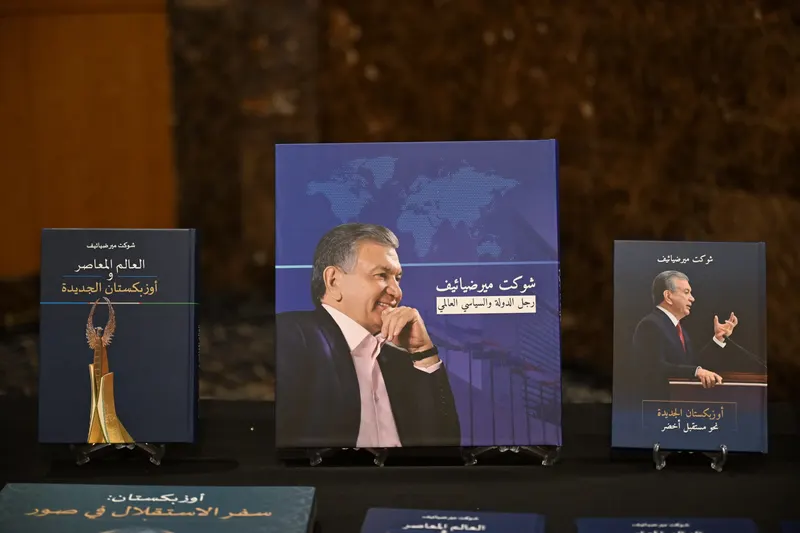
In Amman, the capital of Jordan, the fundamental work of the President of Uzbekistan Shavkat Mirziyoyev titled "The Present Time and the New Uzbekistan" was presented in Arabic.

In Amman, the capital of Jordan, the fundamental work of the President of Uzbekistan Shavkat Mirziyoyev titled "The Present Time and the New Uzbekistan" was presented in Arabic.

The book, consisting of six chapters and a conclusion, analyzes the reforms being implemented on the basis of the principles "The State — for the Person" and "For Human Dignity," the priority tasks of the country's development, and the changes in the life of the state and society.