By 2030, new substations will be built: a 5,000-kilometer power grid will be established
This will make it possible to connect new power plants to the energy system and expand power exchange between regions.
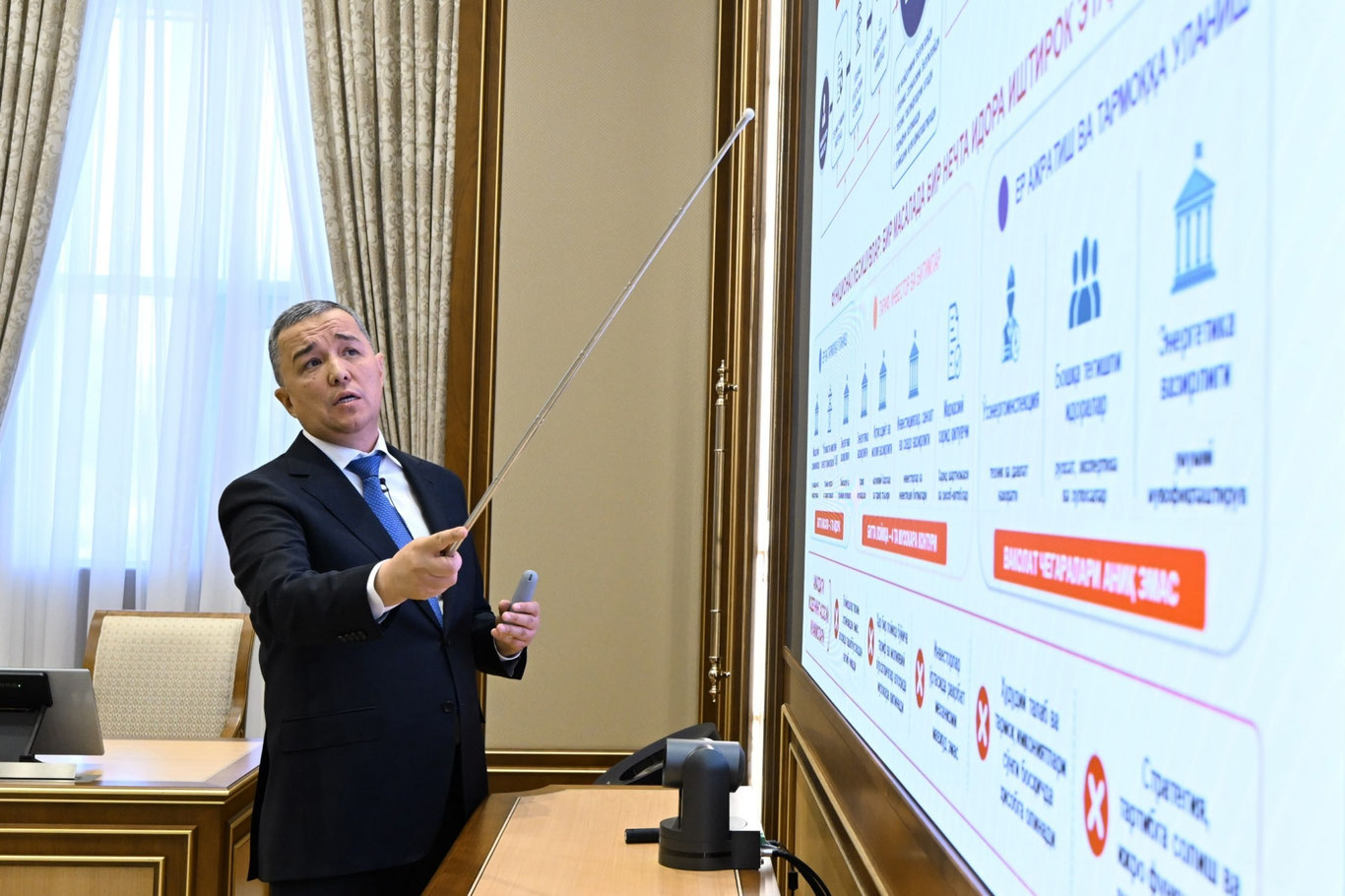
President Shavkat Mirziyoyev was briefed on a presentation regarding the prospects for developing the electric power industry and improving the mechanisms for managing projects in the fuel and energy sector.
It was noted that in recent years, the private sector and foreign investors have been widely attracted to the sector, and major projects have been implemented to create new generation capacities, develop renewable energy sources, and modernize electric grids.
As a result, the total capacity of solar and wind power plants has exceeded 6.3 gigawatts. The number of hydroelectric power plants has increased by more than 100, and their total capacity has reached nearly 2.5 gigawatts.
In the coming years, demand for electricity is expected to increase. In particular, by 2030, electricity consumption in industry is projected to rise from 38 billion kilowatt-hours to 53.5 billion kilowatt-hours. The development of electric vehicles and data centers will also place additional load on the energy system.
Therefore, the need was emphasized to develop generation capacities ahead of demand, increase the throughput capacity of electric grids, and form sufficient reserve capacities.
According to the plan, by 2030, total generation capacities in Uzbekistan will be brought to 46.1 gigawatts, creating the potential to produce nearly 129 billion kilowatt-hours of electricity per year. By 2035, these figures are envisaged to reach 57.2 gigawatts and 154.7 billion kilowatt-hours, respectively.
The presentation also examined various scenarios for electricity consumption growth. It was noted that if the economy, industry, electric transport, and digital infrastructure develop at high rates, additional generation capacities will be needed.
Based on this, proposals were considered for building additional wind power plants and energy storage systems, and accelerating solar and wind energy projects.
It was also stated that certain projects with low economic efficiency, unclear funding sources, or prolonged delays need to be reviewed. When selecting new capacities, the cost of electricity, grid connection feasibility, compatibility with energy storage systems, and impact on the overall energy balance were identified as the main criteria.
Currently, 26 projects with a total capacity of 4.2 gigawatts have been formulated in the area of energy storage systems. Of these, 17 are in the implementation stage. It was proposed to formulate additional projects in this area by 2030.
It was noted that the main grids and substations delivering electricity to consumers must be developed simultaneously with new generation capacities.
By 2030, it is planned to build 9 new 220-kilovolt and 7 new 500-kilovolt substations and construct nearly 5,000 kilometers of new power transmission lines. This will make it possible to connect new power plants to the energy system and expand capacity exchange between regions.
In addition, in 2027–2029, it is planned to commission a number of strategic 500-kilovolt power transmission lines and new substations. The presentation discussed the construction status, financing, and measures to eliminate existing delays in these projects.