Putin also returned empty-handed from China.
Russian leader Vladimir Putin also visited China after Trump. According to analysts, Putin's visit was different from Trump's. The meeting between the two leaders took place in a positive atmosphere. However, according to The Moscow Times, although Putin was welcomed with a red carpet in China, he also failed to achieve any significant results.
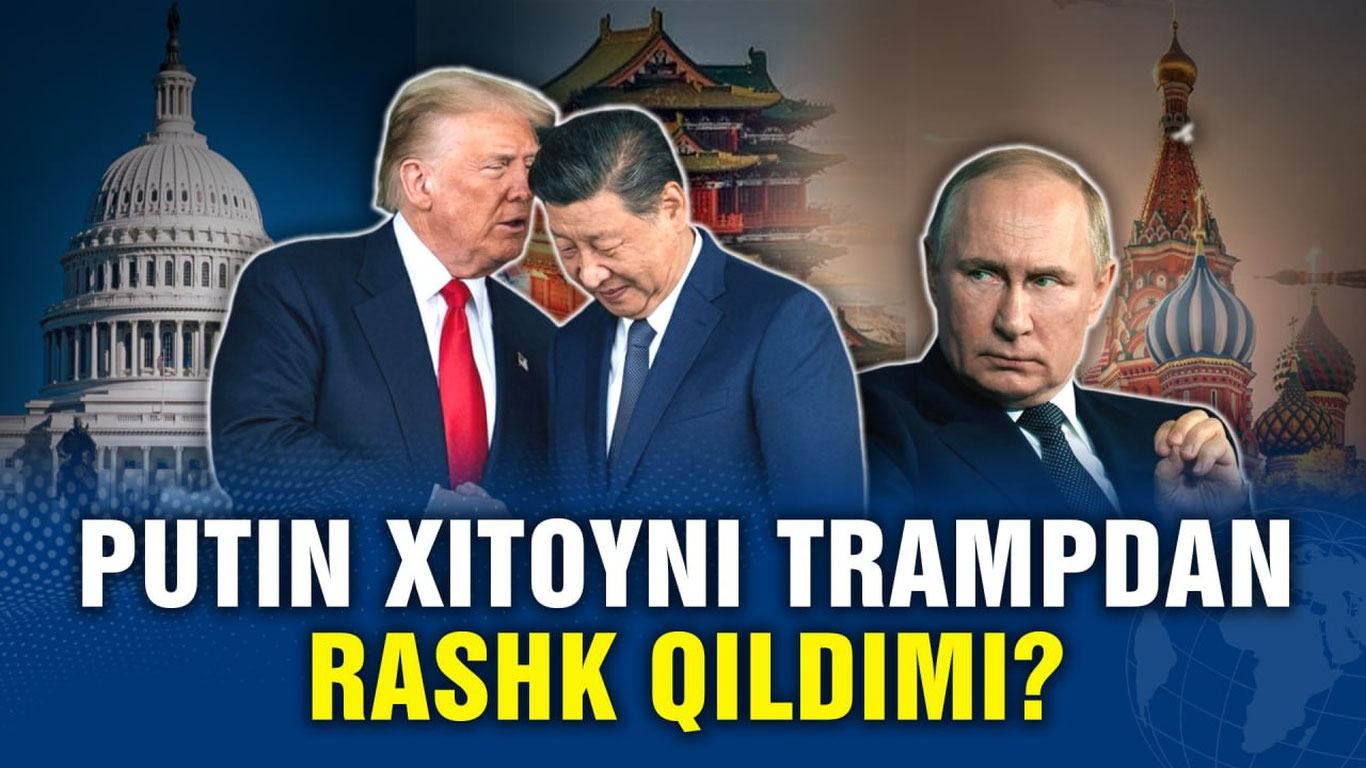
On May 19-20, Russian President Vladimir Putin made an official visit to China. Russian leader Vladimir Putin visited China after Trump. According to analysts, Putin's visit was different from Trump's. The meeting between the two leaders was held in a high-spirited atmosphere.
However, according to The Moscow Times, although Putin was welcomed with a red carpet in China, he also failed to achieve any major results.
Nevertheless, although the Russian delegation signed about 40 agreements strengthening cooperation in areas ranging from trade to technology, it was unable to sign the long-delayed major contract for the "Power of Siberia-2" gas pipeline this time either.
According to experts who informed The Moscow Times on Wednesday, while Putin's visit was modest in terms of concrete practical results (contracts), it compensated for this by demonstrating how vital one of Russia's most important partnerships is.
"In a certain sense, it was more of a symbolic visit, but in foreign policy and high politics, symbols are of great importance," says Temur Umarov, a research fellow at the Carnegie Russia Eurasia Center.
According to The New York Times, Putin, in the absence of Xi Jinping, jokingly mentioned that this visit was taking place on the day 54 years ago when Mao Zedong "called on the entire world to fight against American imperialism." The Russian leader then repeated the usual thesis that Moscow and Beijing are uniting forces not "against" anyone, but only for their own interests and global harmony.
"We are ready to cooperate with everyone, including our partners in the world, particularly the United States," Putin said before the meeting.
During the visit, Xi and Putin tried to present themselves as a force maintaining stability in a world thrown into disorder by Washington.
According to Chinese state media, Xi Jinping told Putin: "The wave of unilateral hegemony is rising."
This was a jab at the United States, which started a war in Iran this year, captured the Venezuelan leader, and blocked the main oil supply routes to Cuba.
What was expected?
Before the Russian leader's official visit to Beijing, Russian media circulated a video showing the abundance of meeting rooms and contracts to be signed. Putin's visit concluded with the parties signing about 40 documents, including a joint declaration "On the formation of a multipolar world and a new type of international relations," as well as a joint statement "On further strengthening comprehensive partnership and strategic cooperation."
This statement, consisting of nearly 10,000 words, is said to cover issues ranging from nuclear security to the protection of Amur tigers.
According to analysts, the main issue between Russia and China was the failure to agree on the construction of the "Power of Siberia-2" gas pipeline. Russian presidential spokesman Dmitry Peskov acknowledged that there is no specific timeline for launching the project.
According to him, there is only a general agreement on the route and key parameters. Important details remain open. In reality, it will take at least 8-10 years to build this pipeline and resolve all issues. For now, Beijing prefers to receive more gas through the existing "Power of Siberia-1" rather than building a new pipeline.
The price of Russian gas planned for delivery via the new pipeline is also unknown. Russian Deputy Prime Minister Alexander Novak announced that Russia and China are finalizing the formalization of supply contracts.
Attempt to change international relations
The Chinese leader called for a complete halt to military operations in the Middle East and called the resumption of attacks an unacceptable mistake. Currently, the Trump administration is considering the possibility of resuming strikes that have been paused since the truce announced last month to force Iran to reopen the Strait of Hormuz.
According to Xi, the turmoil in the Middle East is seriously affecting the Chinese economy, as nearly 40% of Beijing's oil imports pass through the Strait of Hormuz. There are also growing concerns that the closure of the strait could destroy global trade, the main driver of the Chinese economy.
During the visit, China and Russia outlined their vision of a new world order after US leadership in joint documents. It promises states more equality and mutual respect, a call that is completely at odds with Moscow's invasion of Ukraine and Beijing's military displays in Asia.
The two countries jointly warned against a return to "jungle laws" in international relations. Without naming the US, they condemned the "assassination" and "brazen kidnapping" of sovereign leaders to change regimes, as well as "treacherous military strikes against other states."
They also called Trump's plan to build the "Golden Dome" missile defense system an "open threat to strategic stability" and openly stated that US and Israeli strikes on Iran violated international law.
Putin said China's position on the Russia-Ukraine war, which began in 2022, was called "objective and impartial."
Putin stated that, unlike Trump, he views Taiwan as part of China and supports China's actions "to protect its sovereignty and territorial integrity, as well as to unify the country."
"There is only one China in the world, Taiwan is an inalienable part of it, and the government of the People's Republic of China is the sole legal government representing all of China," the joint statement between Putin and Xi said.
Putin and Xi Jinping opposed the new US project to create a missile defense system. The talk is about the "Golden Dome" project – a multi-layered system that should provide complete protection for the entire US territory, including Alaska and the Hawaiian Islands. This project was presented by Donald Trump in May 2025. Russia and China called the "Golden Dome" a "threat to strategic stability."
Putin's visit to Beijing took place just a week after Trump's visit. The US president's negotiations with the Chinese leader yielded no progress on trade relations, and he received no significant help in resolving the conflict with Iran. Putin and Trump were received almost identically – Xi Jinping organized nearly the same ceremonies for them. Reuters reported that both visits demonstrated the growing power of China and its leader.
According to political scientist Mukhtar Nazirov, it is unlikely that the parties will create a defensive weapon like the "Golden Dome" as stated in the joint statement. Russia currently cannot spend that much money. China, on its part, cannot willingly get drawn into a "Cold War."
Russians failed to make enough impression on the Chinese
According to Alexander Gabuyev, director of the Carnegie Russia Eurasia Center, the Russian delegation had hoped for a repeat of the 2014 negotiations on the first line of the "Power of Siberia," which lasted 4 days and nights until the parties agreed on a final formula.
"From the perspective of the crisis in the global market, this was the situation where they could come closest to an agreement, but I think it didn't impress the Chinese that much. Or the Russians are not making the offer attractive enough," Gabuyev said.
Putin has long promoted a world order where Washington, Beijing, and Moscow govern the world themselves, where the US does not have hegemony over the rest, but acts as three major and equal powers.
"Recent relations between the three major powers show that cooperation between China and Russia could create new space for the United States to be involved in processes," said Zhang Xin, a professor at the Center for Russian Studies at East China Normal University.
"The construction of a multipolar world does not mean completely bypassing the US; it only rejects certain hegemonic actions," he added.
According to Putin's foreign policy aide Yuri Ushakov, Putin and Trump could meet in November in Shenzhen, China, possibly on the sidelines of a regional economic forum. Ushakov also said Russia expects to receive Trump's special envoys for peace negotiations, Steve Witkoff and Jared Kushner, in the "coming weeks."
According to political scientist Mukhtar Nazirov, Russia did not have convincing cards in its hands to persuade China. Regarding the question of whose interests the "Power of Siberia-2" project serves more, he answered that Russia has high hopes for this project.
Xi is also paying great attention to strengthening ties with Trump, which could harm China's foreign policy interests (on issues such as tariffs, technological restrictions, and support for Taiwan). The reception ceremony for both Trump and Putin reflected this delicate balancing policy pursued by Xi Jinping.
The red carpet ceremony laid out for Putin was similar to Trump's: an honor guard inspection, a 21-gun salute, and a group of applauding children.
While Trump was greeted at the airport by Chinese Vice President Han Zheng, Putin was greeted by China's top diplomat Wang Yi. According to Yun Sun, director of the China program at the Stimson Center in Washington, although Han Zheng is a higher-ranking official by position, Wang Yi plays a much more active role in foreign policy.
In a statement on Monday, Ushakov said there was "no connection" between Trump's and Putin's visits to China. Ushakov stressed that the Russian leader's visit was pre-arranged and the plan was set a few days after Putin and Xi communicated via video conference on February 4.
Wang Sicheng, deputy secretary-general of the Beijing-based think tank "Center for China & Globalisation," assessed the situation as follows: "Trump's visit was aimed at stabilizing the world's most important bilateral relationship; Putin's visit was characterized by reassuring (instilling confidence in) a long-term strategic partner." Wang also added: "For China, these two directions do not negate each other."
Putin's visit, in contrast, was conducted in a significantly closer and even cordial spirit.