A 1.2-kilometer BRT lane has been put into operation in Tashkent.
As part of the first phase of the BRT project on Shahrisabz Street, new bus stops and a dedicated traffic lane have been established, and the road infrastructure has been completely reconstructed.
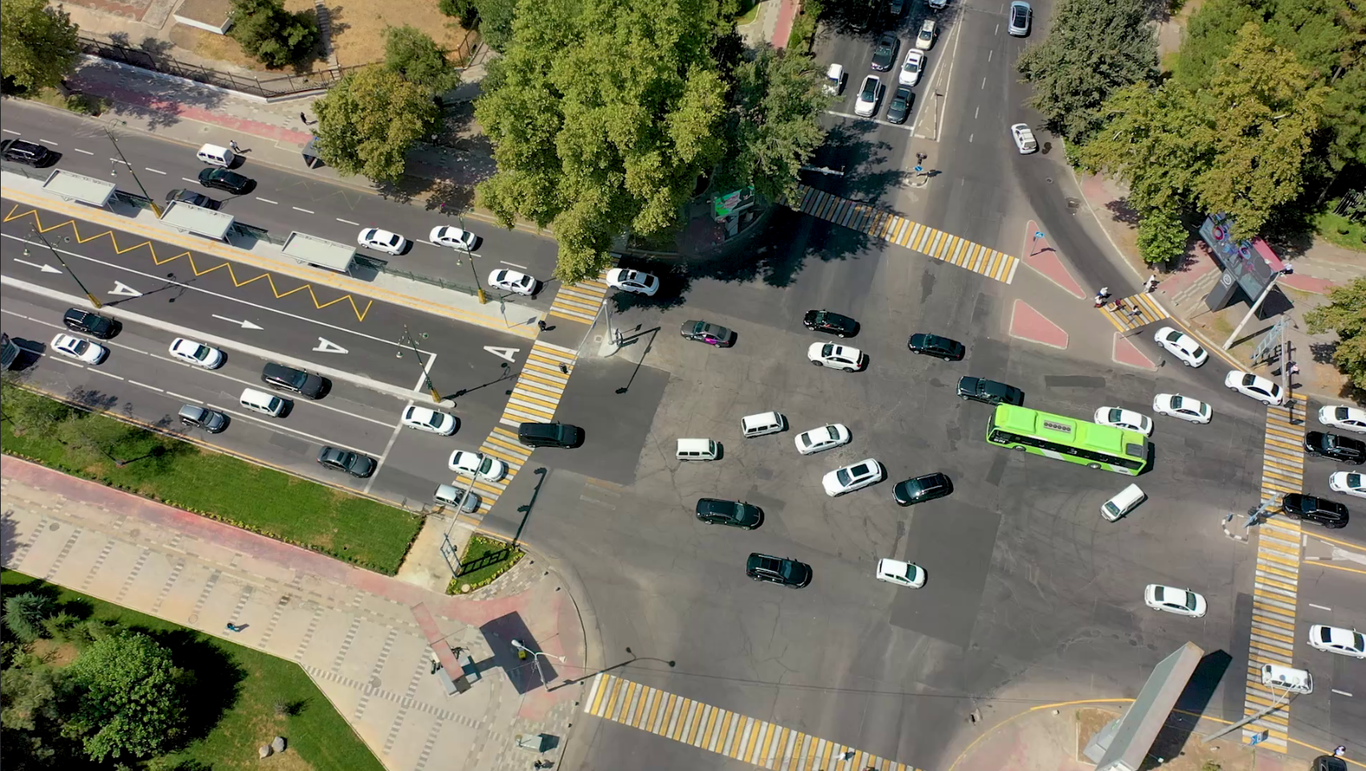
The first phase of the BRT lane on Shahrisabz Street in Tashkent has been put into operation. The Center for Traffic Organization in Tashkent reported this.
This section covers a 1.2-kilometer stretch from the roundabout where Shahrisabz, Mirobod, and Shota Rustaveli streets intersect to the intersection with Amir Temur Avenue.
It was noted that within the framework of the project, not only was the existing road surface renewed, but its underlying structure was also completely rebuilt. In some parts, excavation work was carried out to depths of more than 2 meters, and the road foundation was reshaped. A geotextile layer was laid to reduce soil moisture and the risk of subsequent subsidence.
The road base was composed of a 35-centimeter-thick sand-and-gravel mixture, a reinforcing layer of grade M-75, a 9-centimeter-thick layer of coarse-grained asphalt concrete, and a 5-centimeter-thick layer of PSHMA-20.
Within the BRT infrastructure framework, 5 new bus stops were established, and a dedicated lane for public transport was created. The lane was physically separated from the general traffic flow using curbs.
According to the report, traffic was not completely halted during the construction work. The work was carried out in stages, and traffic was maintained on the outer right lanes in both directions of the street.
The 1.2-kilometer section on Shahrisabz Street is considered the first phase of the project to establish BRT infrastructure. Within the overall project, it is planned to create a BRT lane along approximately 3 kilometers of the street.
Earlier, it was reported that construction and repair work had begun to establish a BRT (Bus Rapid Transit) lane on Shahrisabz Street in the Mirobod district.