NASA's "Artemis II" mission astronauts have successfully landed on Earth.
During the landing process, the external temperature rose to 2,760 degrees, causing a brief communication interruption.
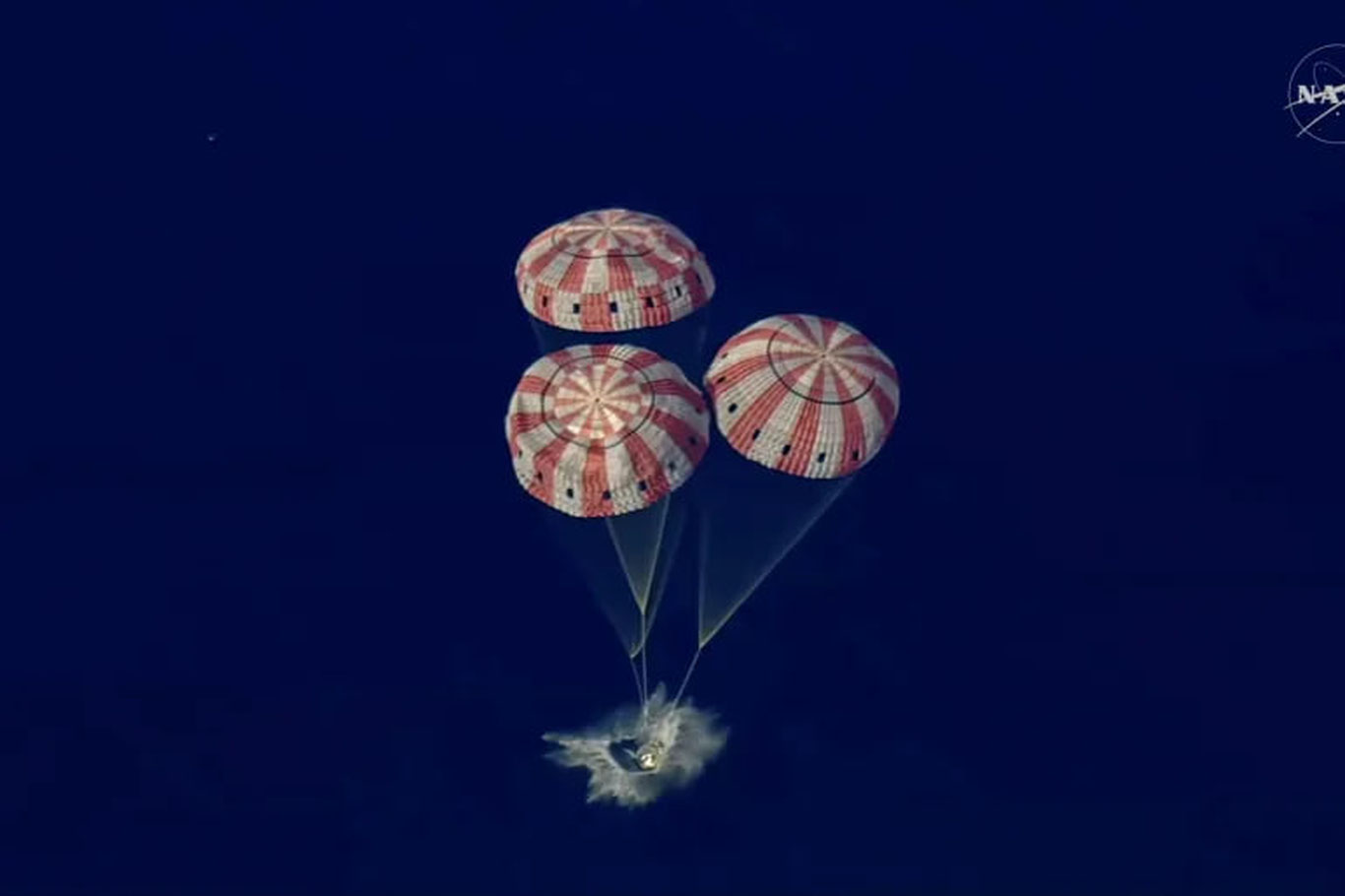
Astronauts who flew around the Moon as part of NASA's "Artemis II" mission have successfully splashed down back on Earth. The process was watched by over 3 million people on NASA's YouTube page.
According to reports, the "Orion" spacecraft splashed down in the Pacific Ocean, near the coast of California, USA, on Friday at 17:07 local time (05:07 on Saturday, Uzbekistan time). The landing occurred after a high-speed re-entry into the atmosphere.
Rescue teams were on standby and promptly began work to secure the capsule and evacuate the crew.
The mission crew consisted of NASA astronauts Reid Wiseman, Victor Glover, and Christina Koch, along with Canadian representative Jeremy Hansen.
Prior to re-entry, mission commander Reid Wiseman noted during a communication with Earth that the Moon had gotten closer. The mission center in Houston indicated the need to return from this historic flight.
Experts emphasized that this phase was a crucial test for the "Orion" capsule, providing a practical opportunity to test technologies designed for lunar flight conditions.
During the atmospheric entry, the capsule endured an intense phase lasting approximately 13 minutes. The external temperature rose to 2,760 degrees, causing a brief communication blackout. After the parachutes deployed, communication was restored, and the capsule landed softly in the ocean.
Rescue service personnel opened the capsule and safely extracted the astronauts. It was reported that their condition was stable, with only some minor technical inconveniences noted.
According to NASA representatives, this flight is a significant milestone within humanity's program to return to the Moon and lays the groundwork for the planned "Artemis IV" mission in the future.
During the mission, the astronauts orbited the Moon and tested systems intended for future flights. They also had the opportunity to observe the far side of the Moon and cosmic phenomena.
NASA assesses this flight as one of the most critical tests on the path to restoring human flights to the Moon in over half a century.