Fires intensify in Greece: Heatwave is causing new disasters across Europe
Hundreds of people have been evacuated from settlements near Athens. Firefighting efforts are also ongoing in France and Spain.
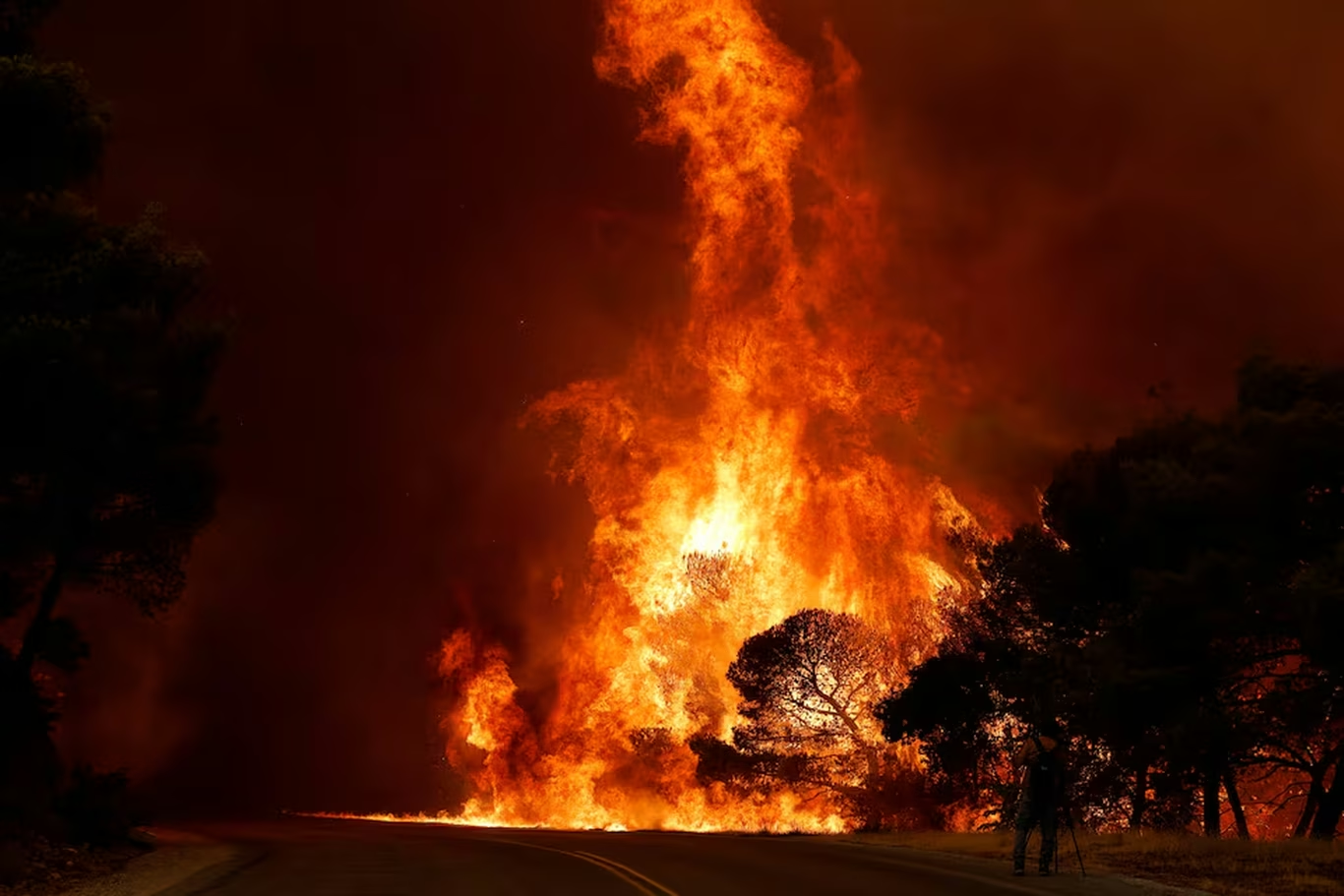
Wildfires are engulfing vast areas in several European countries. In Greece, France, and Spain, strong winds and the ongoing heatwave have complicated firefighting efforts, and thousands of residents are being evacuated to safe areas. Reuters reported on this.
In Greece, on Saturday, large fires broke out in several parts of the country, including near Athens, under the influence of strong winds. Flames engulfed forests and shrublands in the mountainous area of Agia Paraskevi near Porto Germeno. According to officials, the strong wind is making firefighting efforts almost impossible in some areas.
More than 300 firefighters, 92 specialized vehicles, heavy machinery, and aircraft have been deployed to extinguish the fire in the Boeotia region. Over 200 residents from the town of Agios Vasileios were evacuated by sea. Another 12 people were brought to safety from the coast of Porto Germeno with the help of Greek Coast Guard vessels.
According to local media, the fire in the Porto Germeno area spread in three directions, damaging numerous residences. Officials issued an urgent evacuation warning for residents of the settlements of Agia Paraskevi, Kryo Pigadi, and Agios Nektarios.
In the Var department in southeastern France, a fire that had been brought under control three days ago flared up again, covering more than 1,000 hectares within six hours. French Interior Minister Laurent Nunes described the situation as "very serious." He stated that since the beginning of the year, fires have damaged 119,000 hectares in the country.
According to Eric Groen, head of the fire and rescue service in the Var department, temperatures rising to 40 degrees and increasing winds are making it difficult to contain the fire. Nearly 2,500 people were evacuated overnight, and additional forces and equipment were mobilized for firefighting operations.
Deer that escaped the large fire near the French city of Bordeaux are being treated at the Southern Gironde animal reserve. According to experts, some of the animals were burned, while others were injured by colliding with cars or barriers as a result of panic.
In Spain, efforts to extinguish fire hotspots are also ongoing. While a new fire has broken out in the province of León, a fire covering nearly 11,000 hectares in the province of Zamora has been brought under control, and 14 evacuated settlements have been reopened.
In the Vall d'Uixó area in the province of Castellón, all evacuated residents were allowed to return home after the fire that burned nearly 10,000 hectares was stabilized. Police are also investigating the possibility that the fire was deliberately set.
Large fires covering more than 70,000 hectares in the Madrid and Ávila areas have also been brought under control. A new fire that broke out near the San Juan reservoir near Madrid was extinguished on Friday.
Experts note that the record-breaking heatwaves and lack of rainfall observed consecutively in Europe this summer have sharply increased the risk of wildfires. Vegetation that grew after a relatively rainy winter has dried out under the heat, turning into a large amount of natural fuel for fires.
The consequences of extreme heat are also affecting human health. In Austria, 395 heat-related deaths were recorded in June. In the United Kingdom, it is reported that approximately 2,877 people have died due to heat since the beginning of this year. In France, 5,764 excess deaths were recorded between June 17 and July 2, while Germany's Robert Koch Institute estimated the number of deaths related to high temperatures at nearly 9,800.