The presentation of the Center of Islamic Civilization in Uzbekistan was held in Doha
Representatives of Uzbekistan and Qatar are expected to discuss the legacy of great scholars, the development of Islamic sciences, and the prospects for scientific and educational cooperation between the two countries at the presentation.
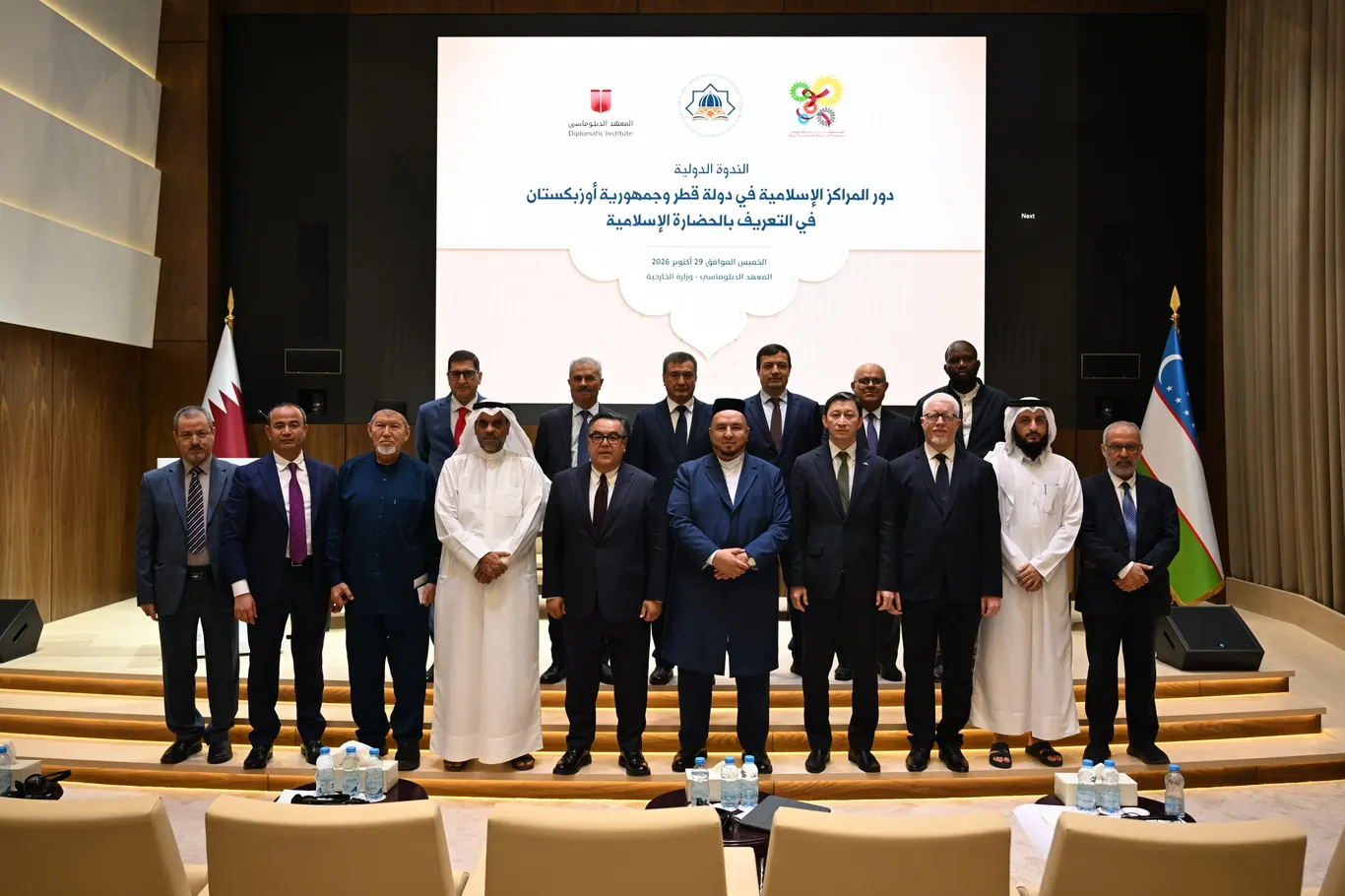
In Doha, the capital of Qatar, a presentation of the Islamic Civilization Center in Uzbekistan is being held to introduce to the general public the mission, scholarly and educational potential, and international cooperation directions of the Islamic Civilization Center in Uzbekistan, established on the initiative of the President of the Republic of Uzbekistan, Shavkat Mirziyoyev. As part of the presentation, an international scientific seminar is planned to be held.
At the presentation and international scientific seminar organized at the Diplomacy Institute of the Ministry of Foreign Affairs of Qatar, representatives of the scientific, cultural, and educational spheres of Uzbekistan and Qatar are expected to participate and discuss the contribution of the scholars of Mawarannahr to the development of world civilization, the development of Islamic sciences, and the prospects for cooperation between the two countries.
The main goal of the presentation is to study in depth the rich scholarly and spiritual heritage of our great ancestors, to promote it on the international stage on the basis of modern approaches, and also to demonstrate Uzbekistan's worthy place in the history of world Islamic civilization.
The presentation was opened with welcoming remarks by the Ambassador of the Republic of Uzbekistan to the State of Qatar, Ashraf Khojayev, the Minister of State of Qatar, Chairman of the Qatar National Library, Dr. Hamad bin Abdulaziz Al-Kawari, and the representative of the Qatar Committee for the Alliance of Civilizations, Dr. Ahmad bin Hasan Al-Hammadi.
When Mawarannahr is mentioned, the names of the great scholars who illuminated the path of humanity's development come to mind. From this land emerged Imam Bukhari, who compiled the most reliable hadiths narrated from the Messenger of Allah, peace and blessings be upon him. Here great scholars such as Imam Termizi and Imam Moturidi reached perfection. This is the homeland of Muhammad Khwarazmi, whose algorithms the whole world still uses. This is the land of Abu Rayhan Beruni, who measured the Earth and gave impartial assessments to nations. This is the land of Ibn Sina, whose work "The Canon of Medicine" served for centuries as one of the main sources of medicine in European universities. This is the land of Mirzo Ulugbek, who observed the stars from his observatory in Samarkand.
Bukhara, Samarkand, and Tashkent were important stations on the Great Silk Road. Through these cities, caravans carried various goods and items, while ideas and masterpieces of thought spread as spiritual wealth that outlived them even longer.
At this point, we express our deep gratitude and high respect to the leadership and people of the Republic of Uzbekistan, especially to the author of this blessed initiative, His Excellency the President of the Republic of Uzbekistan, the esteemed Shavkat Mirziyoyev, for building in Tashkent such a magnificent edifice as the Islamic Civilization Center.
The significance of this center is not limited only to introducing Uzbekistan and its great historical heritage to the world. Of course, this in itself is also an extremely great and important task - said the Chairman of the Qatar National Library, Dr. Hamad bin Abdulaziz Al-Kuwari, in his speech.
At the international scientific seminar within the framework of the presentation, the Director of the Islamic Civilization Center in Uzbekistan, Chairman of the Board of the World Society for the Study, Preservation, and Promotion of the Cultural Heritage of Uzbekistan, Firdavs Abdukhalikov, delivered a special lecture on the topic "The Islamic Civilization Center: Its Mission, Projects, and Areas of Cooperation."
The lecture discussed the strategic goals underlying the establishment of the Center, its research, educational, and international cooperation directions. It was emphasized that this major project, being implemented on the initiative of President Shavkat Mirziyoyev, serves to preserve Uzbekistan's centuries-old scholarly and spiritual heritage, to reveal the contribution of great scholars to the development of world civilization, and to pass it on to future generations.
The head of our state raised the preservation, in-depth study, promotion to the world, and transmission to the younger generation of the heritage of our great ancestors to the level of state policy. He united scientists, researchers, museologists, and creative individuals around a common goal. At the center of this idea stands the human being, his knowledge, spirituality, and future. Every work created by our ancestors, every discovery they left behind, should become a source of new opportunities for today's generation.
We strive to show the scholar's thought behind every work, the research and labor behind every discovery, and the attention to science behind every historical rise. History must speak. Cultural heritage must communicate with people.
The past must inspire today's generation to new knowledge and new discoveries. For us, the most important result is that a passion for knowledge awakens in the heart of a young person who comes to the Center. May he understand the achievements of his ancestors, set great goals for himself, seek, create, and strive to contribute to the progress of humanity.
We see our responsibility before the heritage in four tasks: to preserve, to study, to enrich, and to pass on to future generations. By preserving the heritage, we preserve our memory; by studying it, we enrich our thought; by creating new knowledge, we ensure the continuity of civilization, - said the director of the center.
In the main lectures of the scientific seminar, various aspects of the great scientific schools formed on the soil of Uzbekistan and the heritage of scholars were discussed.
Shaykh Abdulaziz Mansur, a research fellow at the Islamic Civilization Center in Uzbekistan, delivered a lecture on the topic "The Uthman Mushaf — A Sacred Monument of Uzbekistan and the Entire Muslim World." It focused on the historical and spiritual significance of the Uthman Mushaf in the Islamic world.
The Dean of the Faculty of Sharia at Qatar University, Dr. Ibrahim al-Ansari, spoke about the contribution of the scholars of Mawarannahr to the sciences of the Qur'an and hadith. The Deputy Dean of the Faculty of Sharia and Islamic Studies at Qatar University, Dr. Muhammad al-Musleh, illuminated the significance of Imam Termizi's work "Sunan" in modern Islamic education.
The Chairman of the Khwarazm Ma'mun Academy, Ikrom Abdullayev, delivered a lecture on the topic "The Khwarazm Ma'mun Academy: The Place of the Heritage of Khwarazmi and Beruni in World Science," focusing on the significance of this scientific school in the history of world science.
Also, the Director of the Center for the Study of the Contribution of Muslims to Islamic Civilization at Hamad bin Khalifa University, Professor Aisha al-Mannai, expressed her views on the contribution of Central Asian scholars to Islamic civilization. The Director of the "Al-Fanar" Center for Introducing Islam, Dr. Salih al-Marri, participated with a lecture dedicated to the teachings of Imam Moturidi and the values of moderate Islam. The Associate Professor of the Department of Dialogue of Civilizations at Qatar University, Professor Dr. Izzuddin Ma'mish, illuminated the place of Uzbekistan and Qatar in the dialogue of civilizations.
This conference is an important step for future cooperation between Qatar and Uzbekistan. Both states play an important role in widely promoting Islamic culture, studying the contribution of Muslim scholars to the development of world civilization, and promoting the ideas of peace.
Qatar is ready to share its experience in teaching the Arabic language, digitizing manuscripts, and modern technologies. Uzbekistan, through its rich historical and cultural heritage, can further develop this cooperation. Joint scientific research, international conferences, and cultural projects will serve to strengthen ties between the two peoples. Insha'Allah, cooperation between Qatar and Uzbekistan will develop further in the future, - said Muhammad Modassir Ali, senior research fellow at the Center for the Study of the Contribution of Muslims to Islamic Civilization at the Faculty of Islamic Studies of Hamad bin Khalifa University in Qatar.
Within the framework of the event, an exhibition of publications of the Islamic Civilization Center in Uzbekistan was also organized, and participants were given the opportunity to familiarize themselves with books reflecting the rich historical and scholarly-spiritual heritage of our country.
In the final session, the results of the presentation were summarized, and issues of prospects for cooperation in the scientific, cultural, and educational spheres, establishing new partnership ties, and implementing joint projects were discussed.
This international presentation held in Doha became one of the important initiatives aimed at widely introducing Uzbekistan's rich scholarly and spiritual heritage to the world community, objectively studying and promoting Islamic civilization, and also strengthening scholarly and educational ties between Uzbekistan and Qatar.